Airtable Data Sync

- Standard Data Sync functionality
- Configuring an Airtable Data Sync
- Step 1: Start the Sync Setup
- Step 2: Choose the apps to connect
- Step 3: Start from scratch or use a template
- Step 4: Select the type of data to sync
- Step 5: Choose when records should be synced
- Step 6: Choose the sync direction
- Step 7: Connect and set up your apps
- Step 8: Choose and map your data
- Step 9: Generate the sync preview
- Review the sync preview
- Start Sync
- Airtable View Sync
- Creating missing select and multi-select options
- Airtable Permissions
This comprehensive document will walk you through the step-by-step configuration process for Airtable data sync and address specific use cases tailored to Airtable.
Standard Data Sync functionality
Please refer to Data Sync - Getting Started for the standard data sync functionality. The getting started document covers usages of data sync features valid for all integrations.
Configuring an Airtable Data Sync
Follow these steps to configure your Airtable sync. After completing the setup, Byteline will generate a preview of the changes that will be made when the sync starts.
Step 1: Start the Sync Setup
- Log in to your Byteline account.
- Go to the My Syncs page.
- Select Create Sync.
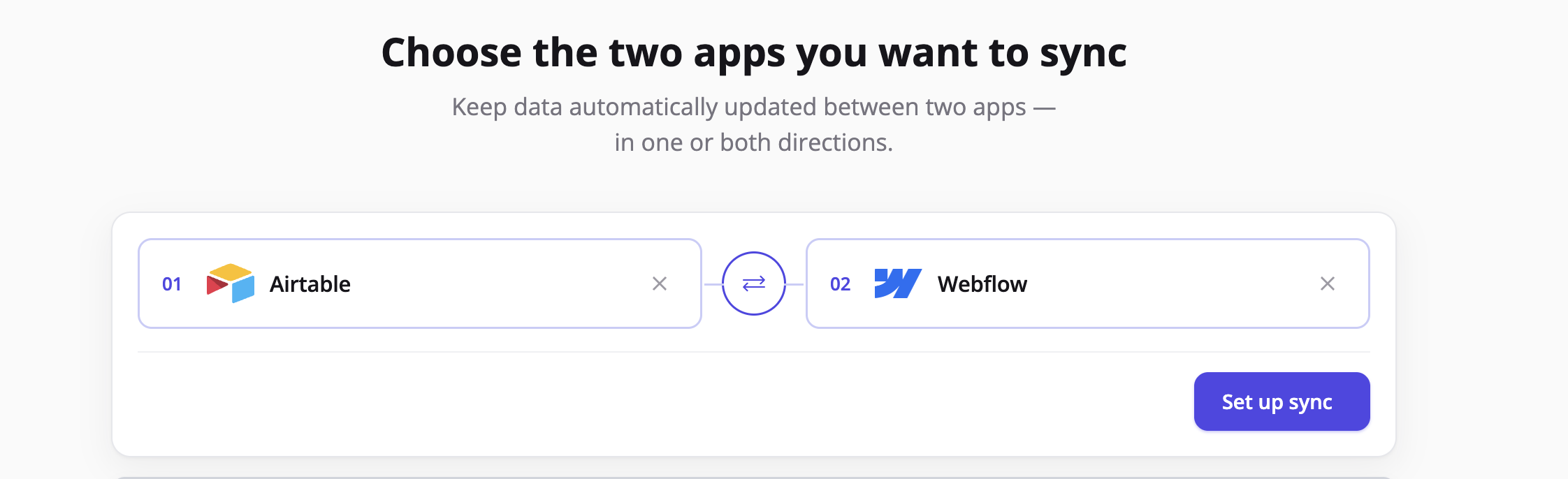
Step 2: Choose the apps to connect
Select Airtable as one of the apps in your sync.
You can choose Airtable as either the first or second app, depending on the direction in which you want your data to move.
After selecting both apps, click Set up sync.
Step 3: Start from scratch or use a template
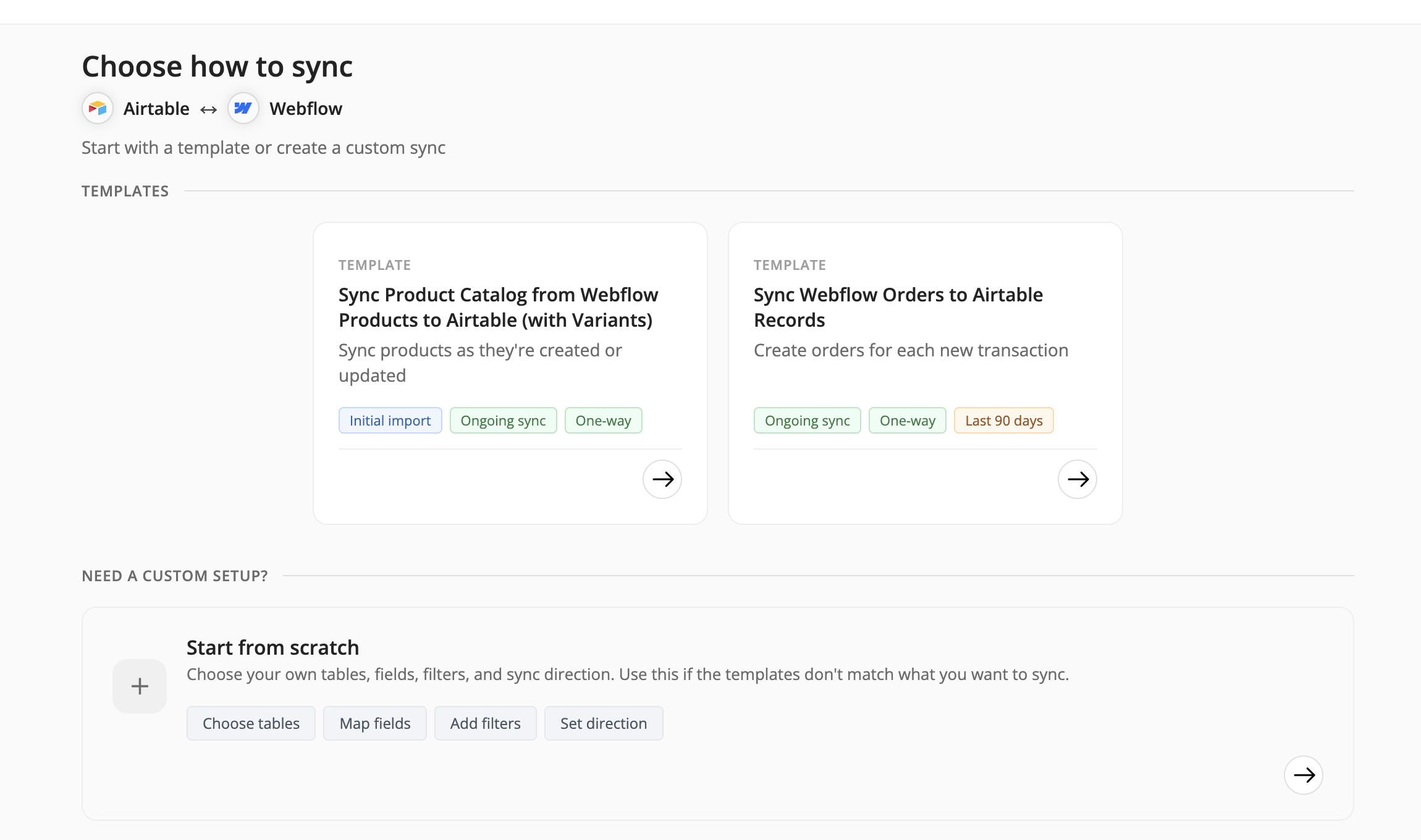
Choose how you want to configure the sync:
- Start from scratch: Configure each part of the sync yourself.
- Use a template: Start with a recommended configuration for a common use case.
Templates can make setup faster when one matches your requirements. In this guide, we will select Start from scratch.
Step 4: Select the type of data to sync
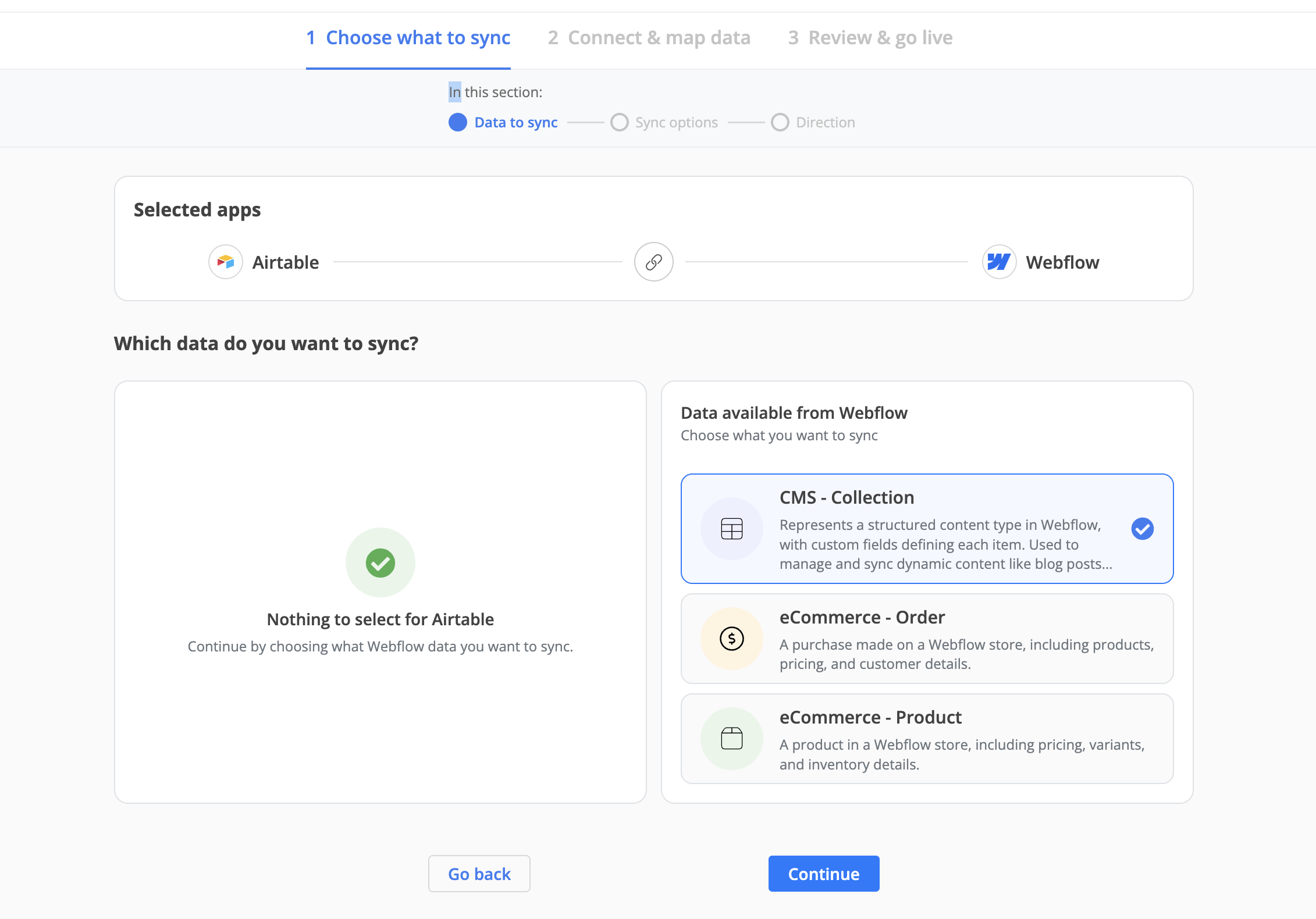
Some apps contain multiple types of data, such as contacts, products, orders, or collection items. When prompted, select the type of data you want to sync.
You do not need to select a data type for Airtable. You will choose the Airtable base and tables later during setup.
Step 5: Choose when records should be synced
Select which records Byteline should include:
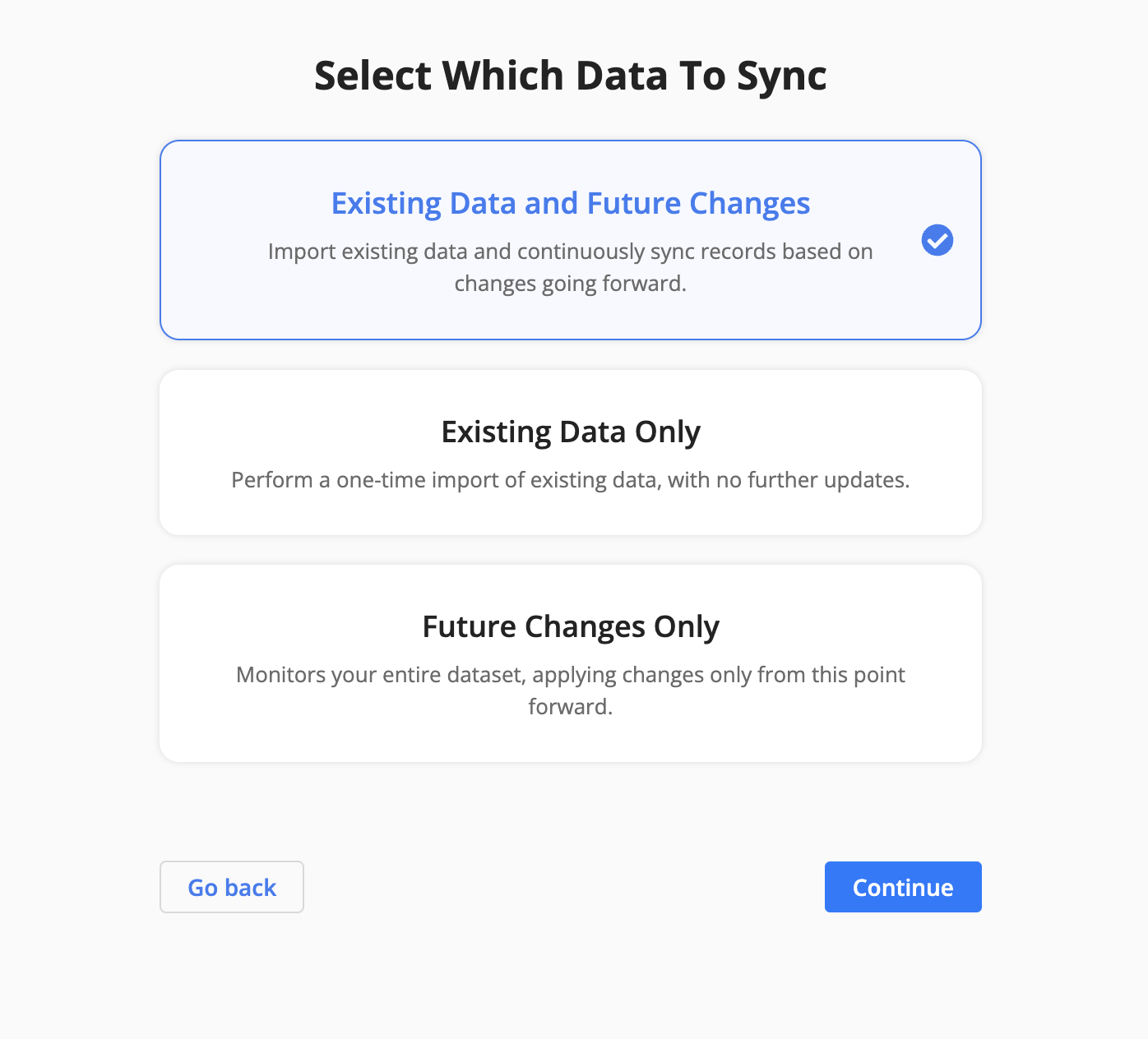
- Existing data: Sync records that are already in your apps.
- Future changes: Sync new records and changes made after the sync starts.
- Existing data and future changes: Sync the current records first, and then keep future changes synchronized automatically.
A sync preview is generated when your configuration includes existing data. If you select future changes only, you can start the sync without reviewing an initial data preview.
Select whether to sync existing records, future changes, or both.
Step 6: Choose the sync direction
Select the direction in which data should move between the two apps.
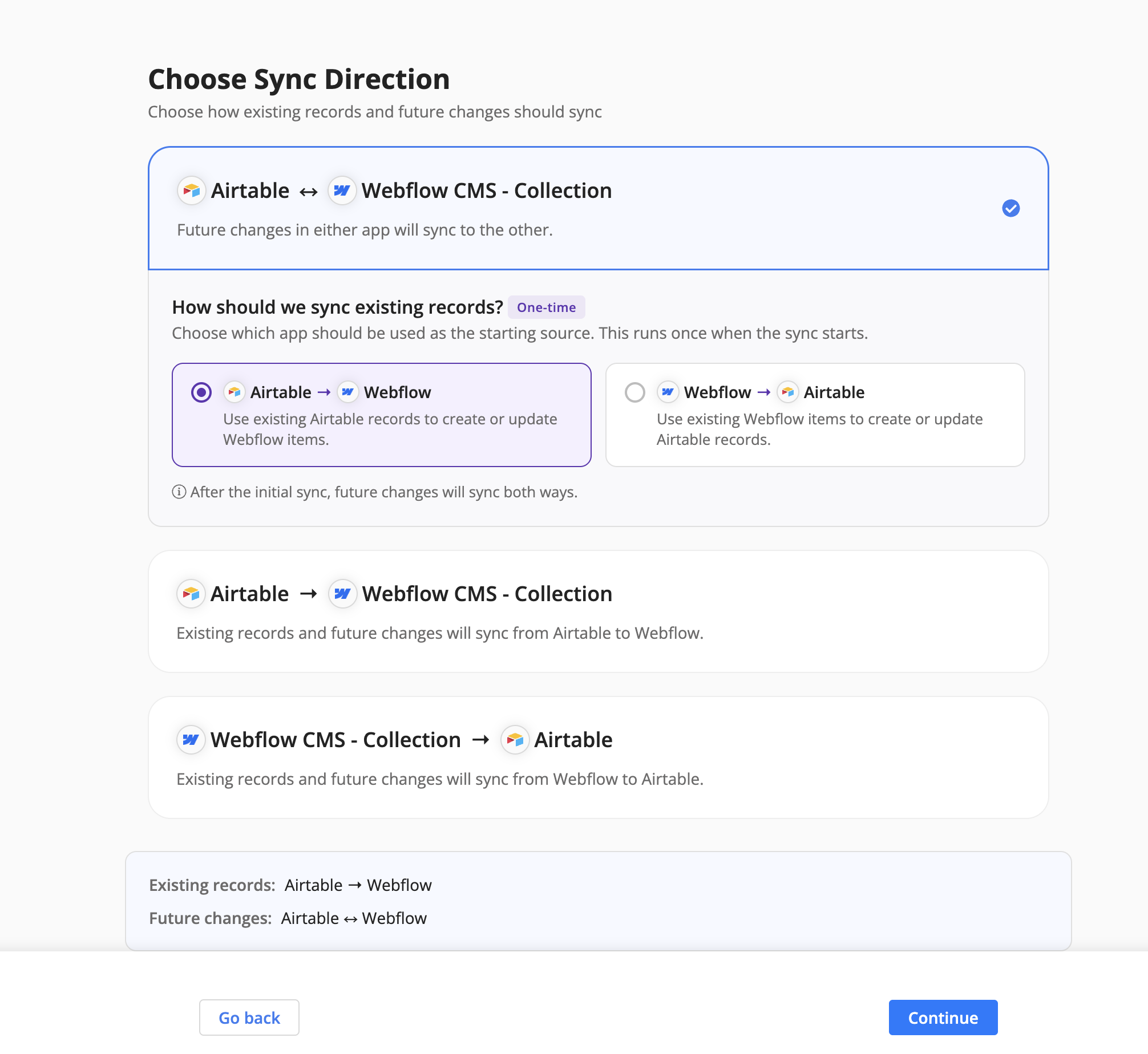
Depending on the apps and data types selected, you may be able to choose:
- One-way sync: Changes move from one app to the other.
- Two-way sync: Future changes move in both directions.
The initial sync of existing records can only run in one direction. Therefore, when you select a two-way sync, you must also choose which app should be the source for the initial data sync.
For example, you can initially copy existing records from Airtable to Webflow and then keep future changes synchronized in both directions.
Step 7: Connect and set up your apps
Next, connect the accounts that Byteline will use for the sync.
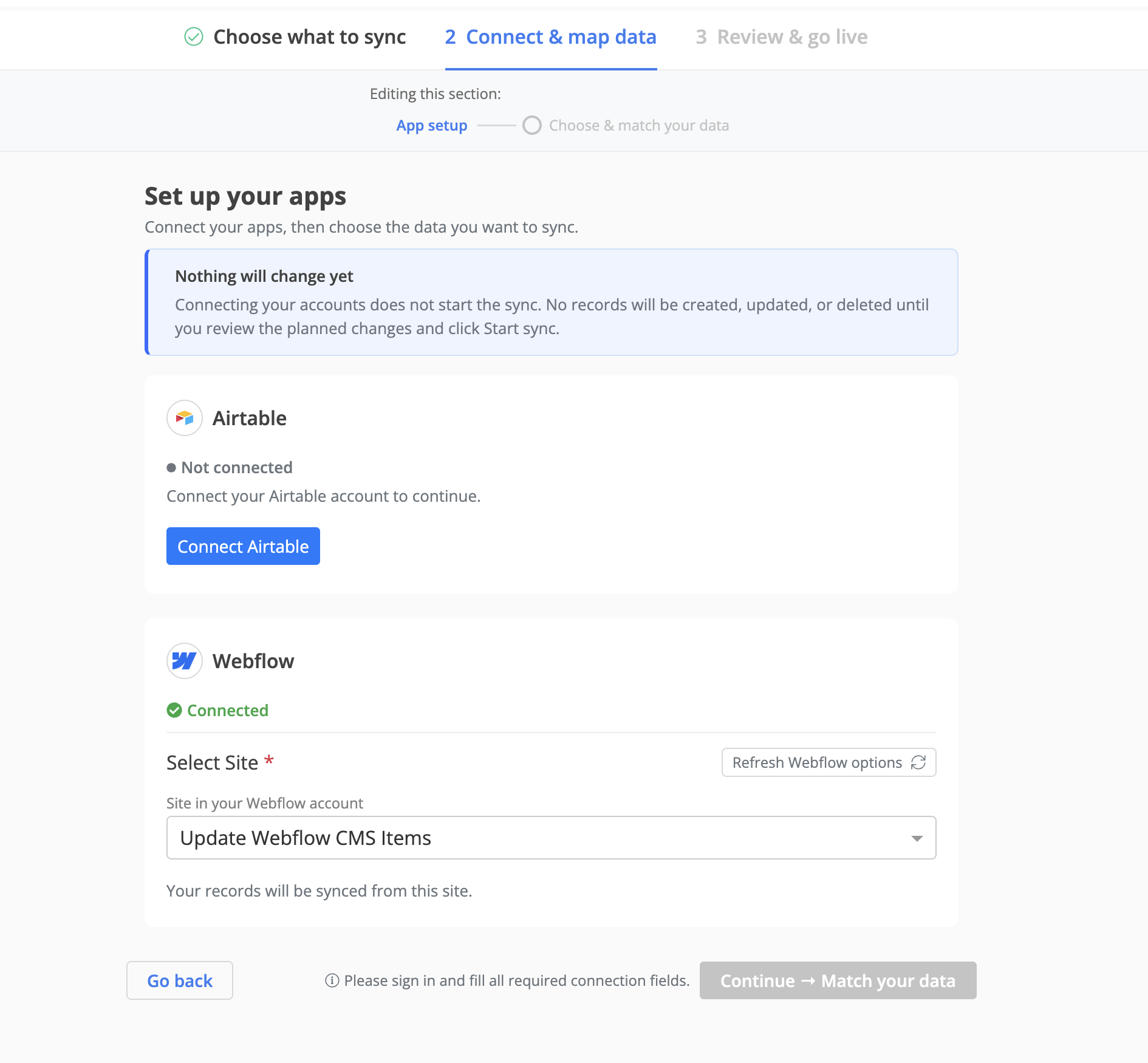
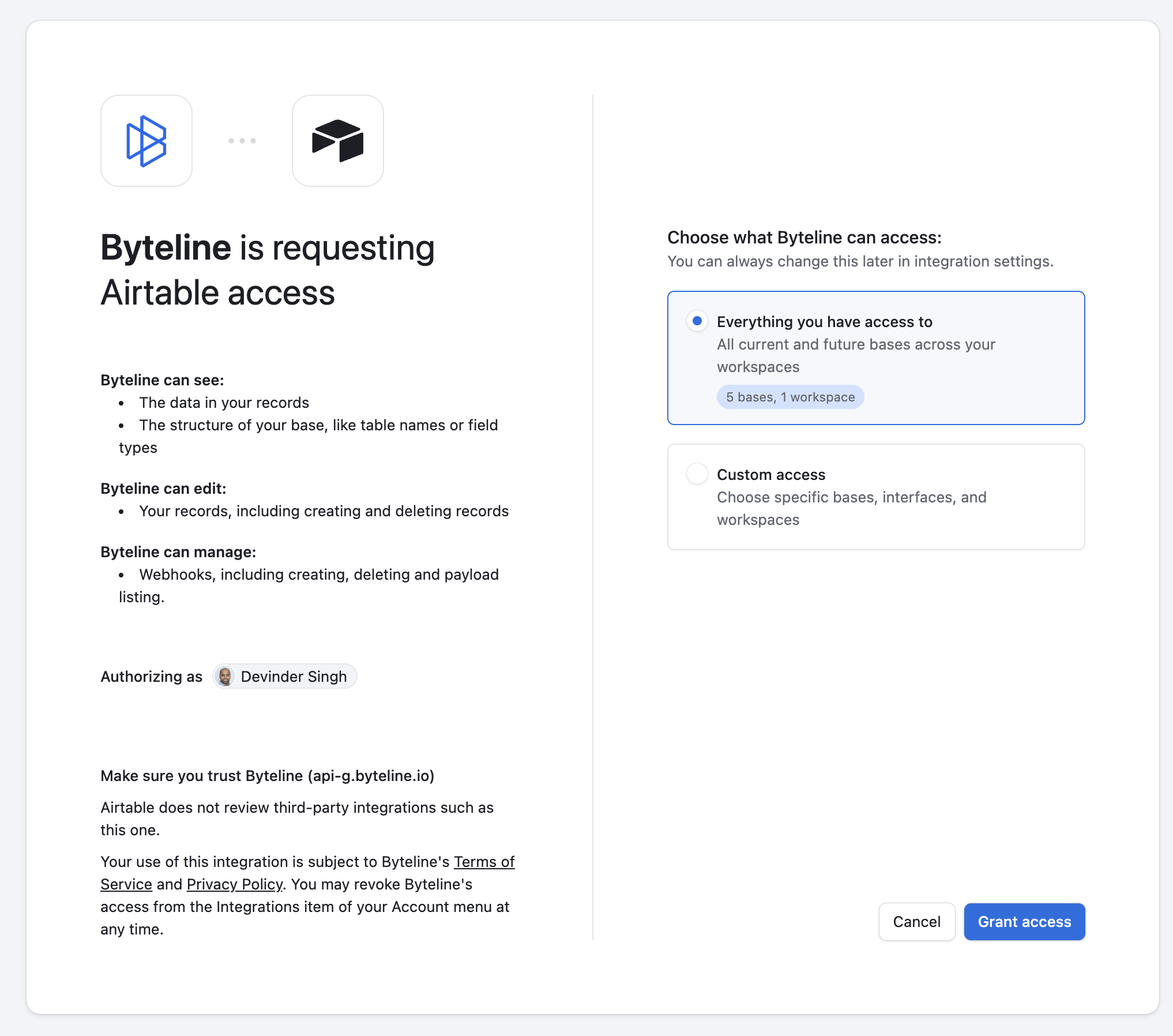
If Airtable is not already connected, click Connect Airtable. You will be taken to Airtable’s authorization screen, where you can approve the bases and workspaces that Byteline is allowed to access.
After the connection is complete
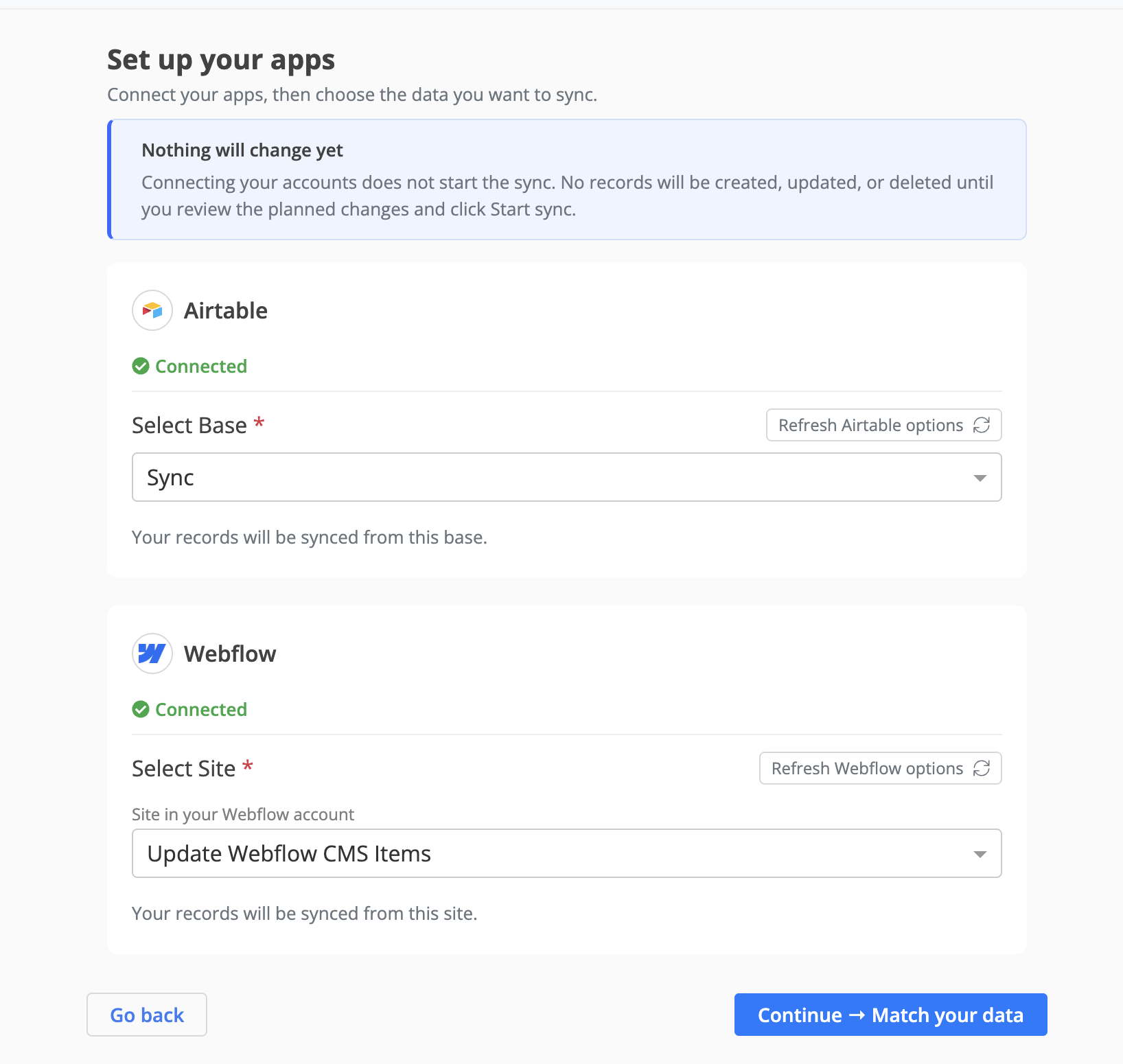
- Select the Airtable base you want to use.
- Complete any additional setup required for the other app.
- Click Continue – Match your data.
Step 8: Choose and map your data
In this step, you will choose which tables should be synced and how their fields should be matched.
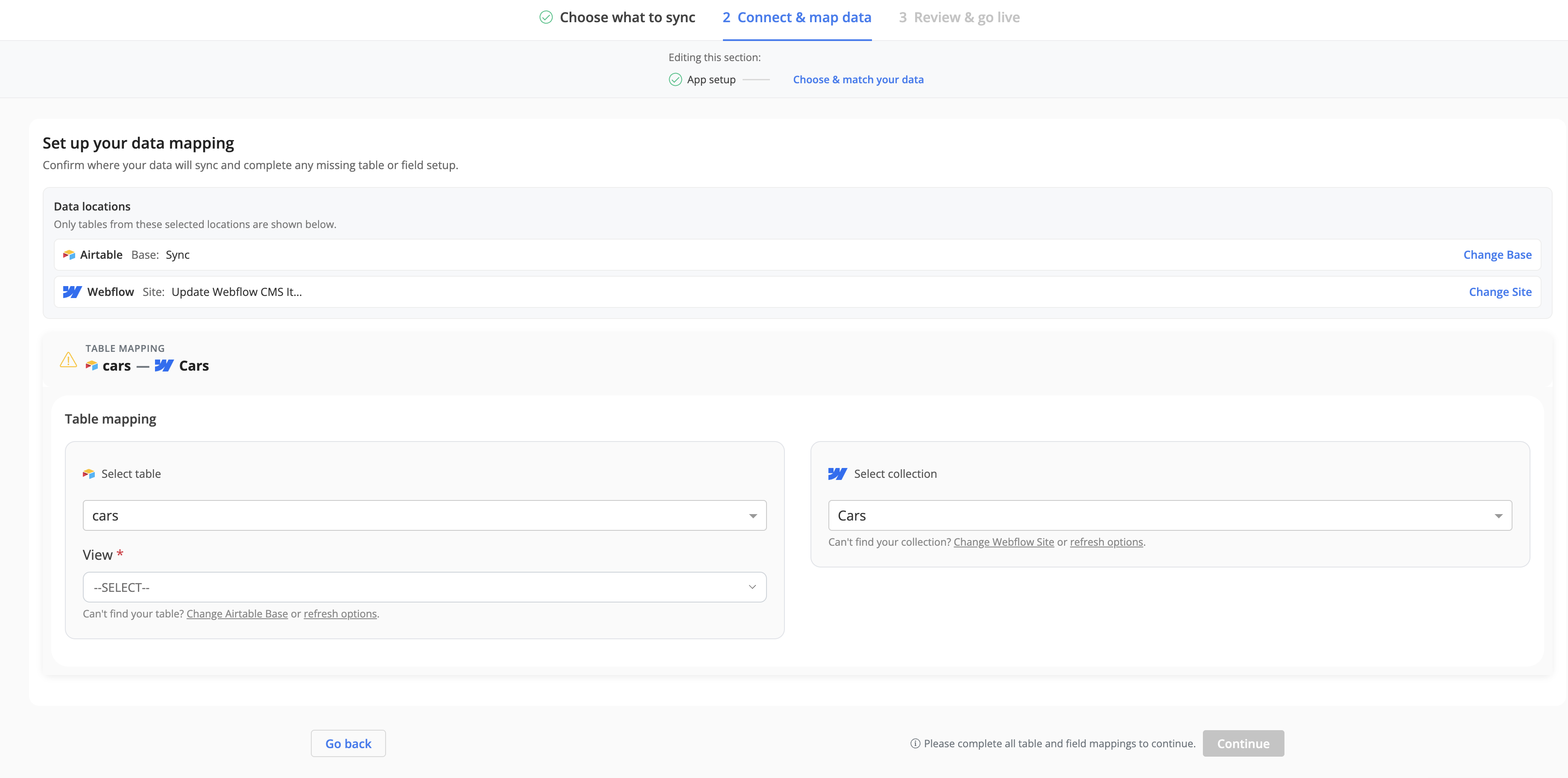
Review the table mapping
Byteline automatically suggests table mappings based on table names and the data available in each app.
Review the suggested mapping before continuing. To change the selected table or its settings, click More, and then select Edit table settings.
Review the field mapping
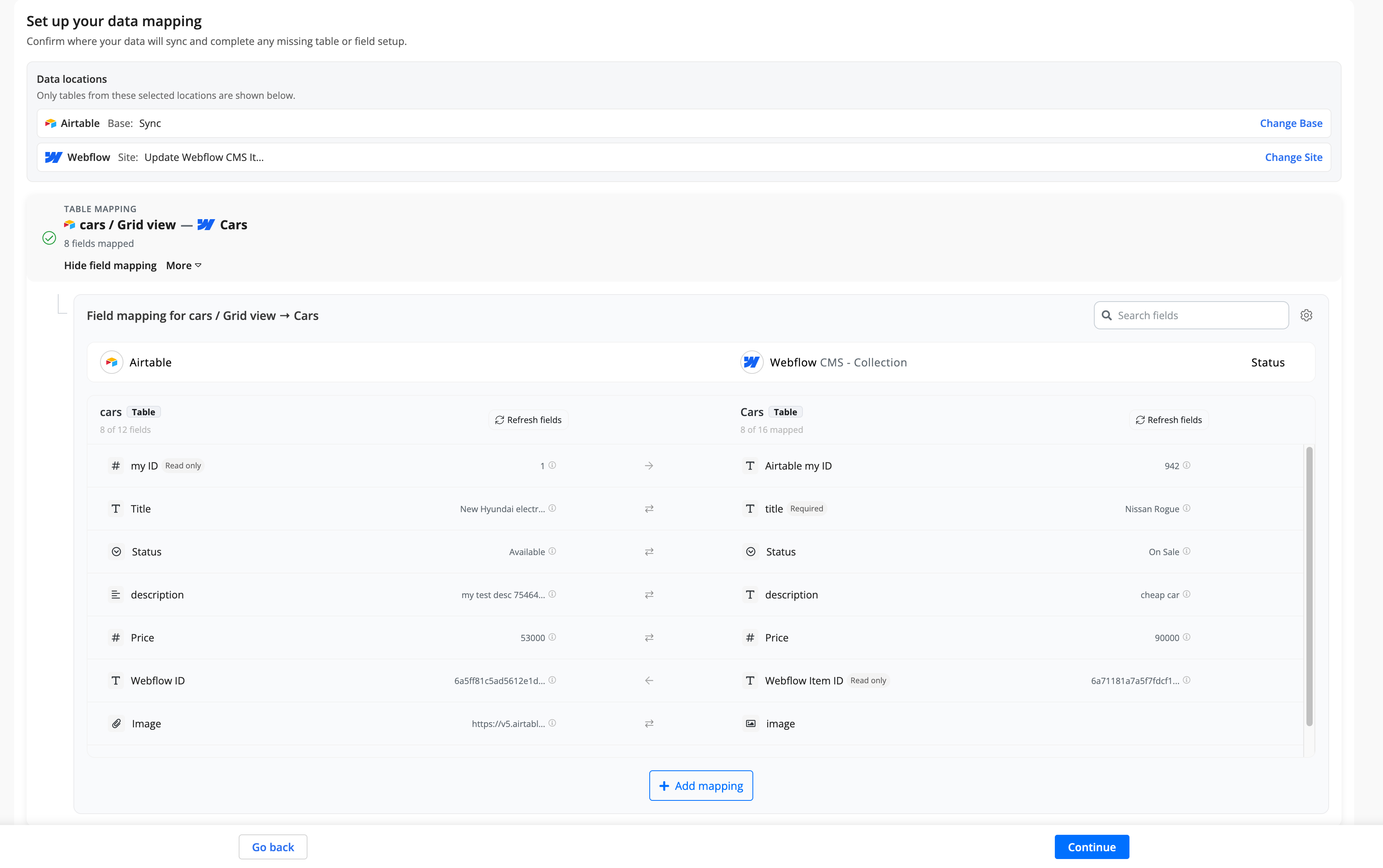
After a table is selected, Byteline automatically suggests mappings between fields that appear to contain similar information.
The field mapping is initially shown in a collapsed view. Click Show field matching to review the complete mapping.
From the detailed field-mapping view, you can:
- Review the automatically matched fields.
- Change an existing field mapping.
- Remove a mapping that you do not need.
- Click Add mapping to include additional fields.
- Review the direction in which each field will be synchronized, when applicable.
Make sure important fields are mapped correctly before continuing. During the initial sync, mapped destination fields may be overwritten with values from the source app.
Step 9: Generate the sync preview
After reviewing the table and field mappings, click Continue.
Byteline will analyze the records in both apps and generate a preview showing how many records will be created, updated, or deleted.
No records are changed while the preview is being generated or reviewed. Changes begin only after you review the preview and start the sync.
Review the sync preview
When your sync includes existing data, Byteline shows a preview before the sync starts. The preview explains what will happen to your current records and how future changes will be handled.
Nothing is changed while you are reviewing the preview. Changes begin only after you select Start sync now.
A preview is not shown when you choose to sync future changes only, because no existing records will be added, updated, or deleted. In that case, you can start the sync directly.
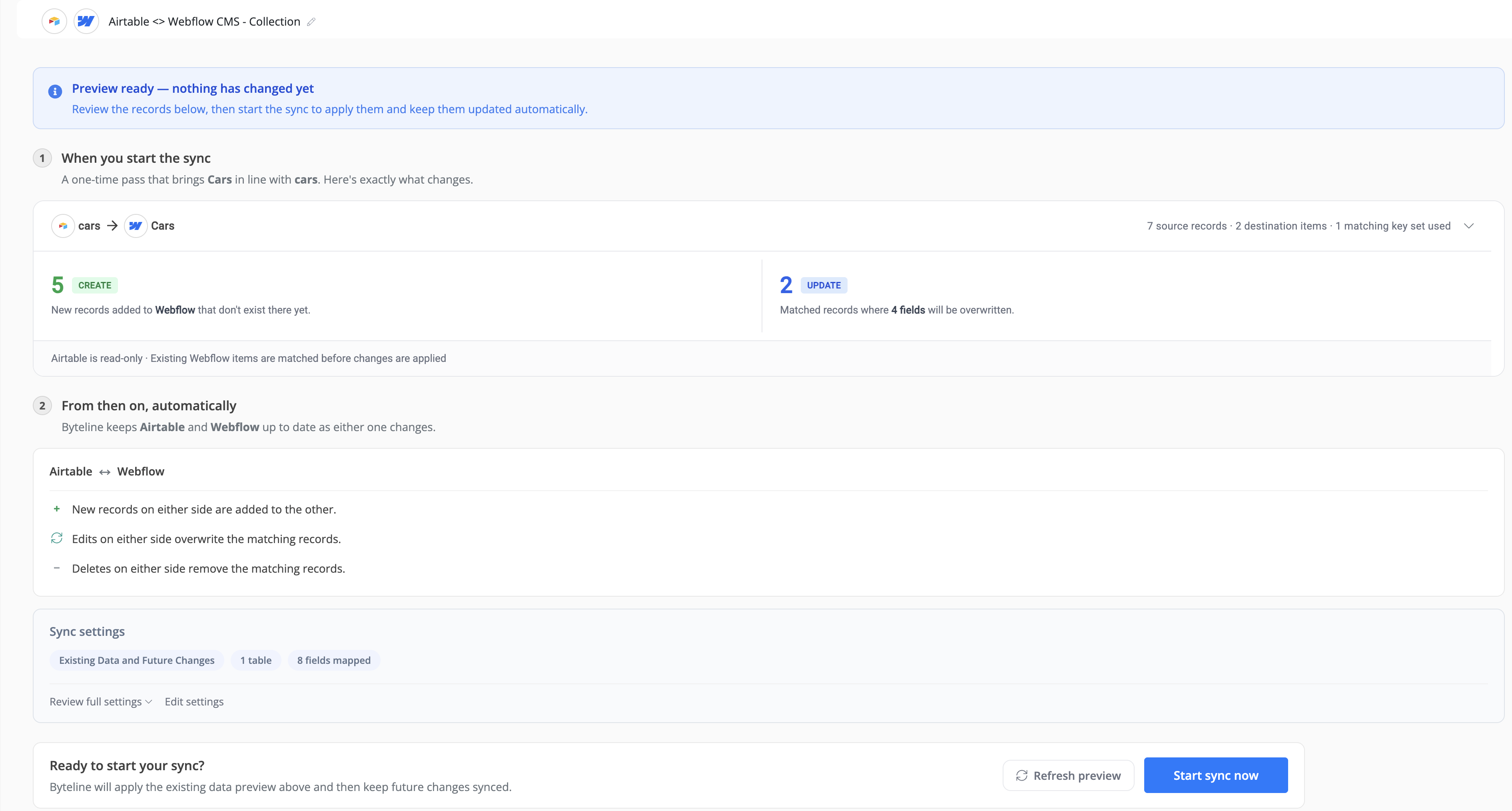
When you start the sync
This section shows the changes Byteline will make during the initial sync of your existing data.
For each table or collection, you will see the number of records that will be:
- Created: New records that will be added because they do not already exist in the destination.
- Updated: Existing records that were matched and whose mapped fields will be overwritten with the latest values.
- Deleted: Existing records that will be removed based on the delete behavior selected in your sync settings.
Expand a table or collection to review more information about the affected records. Pay particular attention to updates and deletes before starting the sync.
The summary also shows:
- The number of records found in the source and destination.
- How many matching keys were used to identify corresponding records.
- Whether one side of the sync is read-only.
- Which fields will be updated.
From then on, automatically
This section explains what will happen after the initial sync finishes and the sync becomes live.
Depending on the direction and settings you selected, Byteline can automatically:
- Add newly created records to the other app.
- Copy edits to the matching record.
- Remove matching records when a record is deleted.
For a two-way sync, changes may move in either direction. For a one-way sync, changes move only from the source app to the destination app.
Review the sync settings
The Sync settings section provides a summary of your configuration, including:
- Whether existing data, future changes, or both are included.
- The number of tables or collections being synced.
- The number of mapped fields.
Select Review full settings to see additional details. Select Edit settings when you need to change the sync configuration before starting.
After changing the settings, return to the preview and make sure the results are still what you expect.
Refresh the preview
The preview is based on the records and settings available when it was generated. The results may change when:
- Records are added, edited, or deleted in either app.
- You change field mappings, filters, matching rules, or delete behavior.
- Some time has passed since the preview was generated.
Select Refresh preview to recalculate the creates, updates, and deletes using the latest data.
Start Sync
Once you have reviewed the preview and confirmed that the changes look correct, select Start sync now.
- Byteline will:
- Perform an initial sync of your existing data.
- Keep the sync running automatically, ensuring your Airtable data stays up to date.
You can monitor sync progress, view logs, or make changes anytime from the Syncs page. If you need to pause or edit the sync, simply open it from your dashboard.
✅ That’s it! Your Airtable sync is now live.
Airtable View Sync
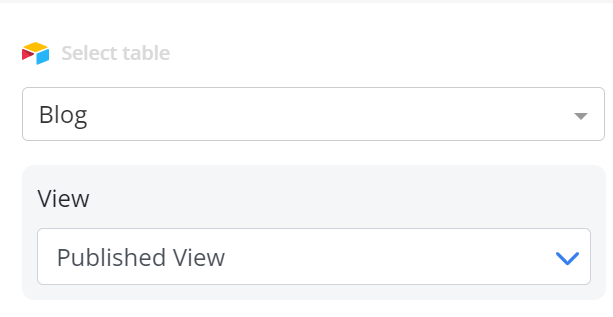
You can sync data that is specific to an Airtable view, which is used to filter and organize your data. When you configure an Airtable data sync, Byteline requires a view to be specified. By selecting a specific view, only the relevant data contained within it will be synced. This applies to both historical syncing, for existing data, and ongoing synchronization.
You can configure a view during the sync creation as shown in the below screenshot.
⚠️ Limitation — When a View Filter Condition Is Not Based on Record Changes
When your Airtable sync is configured using a filtered view, most filters work perfectly because Airtable sends a webhook whenever a record is created, updated, or deleted — and Byteline Sync reacts immediately.
However, if your view includes conditions that can change without the record itself being modified, Airtable does not fire a webhook for those transitions. Examples include:
- Filters using
TODAY(),NOW(), or other time-based formulas
What happens in this case?
If a record stops matching the view due to one of these non-record-change conditions:
- Airtable does not emit a webhook
- Byteline does not receive a change event
- The record quietly leaves the view, and therefore leaves the sync scope
- The corresponding removal/update will not be applied in the destination app
Recommended Workarounds
You can use either of the following approaches to avoid this limitation.
Option 1: Use Byteline Sync Filters
Instead of using a filtered Airtable view to control which records are included in the sync, you can select an unfiltered Airtable view and configure the filtering conditions directly in Byteline.
For example, instead of creating an Airtable view that only includes records where:
StatusisActiveCategoryis notInternal
you can configure the same conditions using Byteline Sync Filters.
This keeps the rules that determine which records participate in the sync directly within your Byteline sync configuration and avoids relying on Airtable view membership changes.
Recommended: If your Airtable view is mainly being used to control which records should be synced, consider using Byteline Sync Filters instead.
Option 2: Use a Helper Field in Airtable
If you prefer to continue using a filtered Airtable view:
- Add a helper field in Airtable, such as
Sync StatusorActive Today. - Use an Airtable automation or other process to update that field when your condition becomes true or false.
- Use the helper field in your Airtable view filter.
Because the helper field is actually updated on the record, Airtable generates a change event that Byteline can detect and sync.
Creating missing select and multi-select options
When syncing data to an Airtable Single select or Multiple select field, the incoming value must already exist as an option in that Airtable field.
For example, if Byteline tries to sync the value “Urgent” to a Priority field, but “Urgent” is not an available option in Airtable, the affected record cannot be synced. Byteline will display a warning for the affected records.
Using the quick fix
For supported warnings, Byteline provides a quick fix that can create the missing option and retry the affected records.
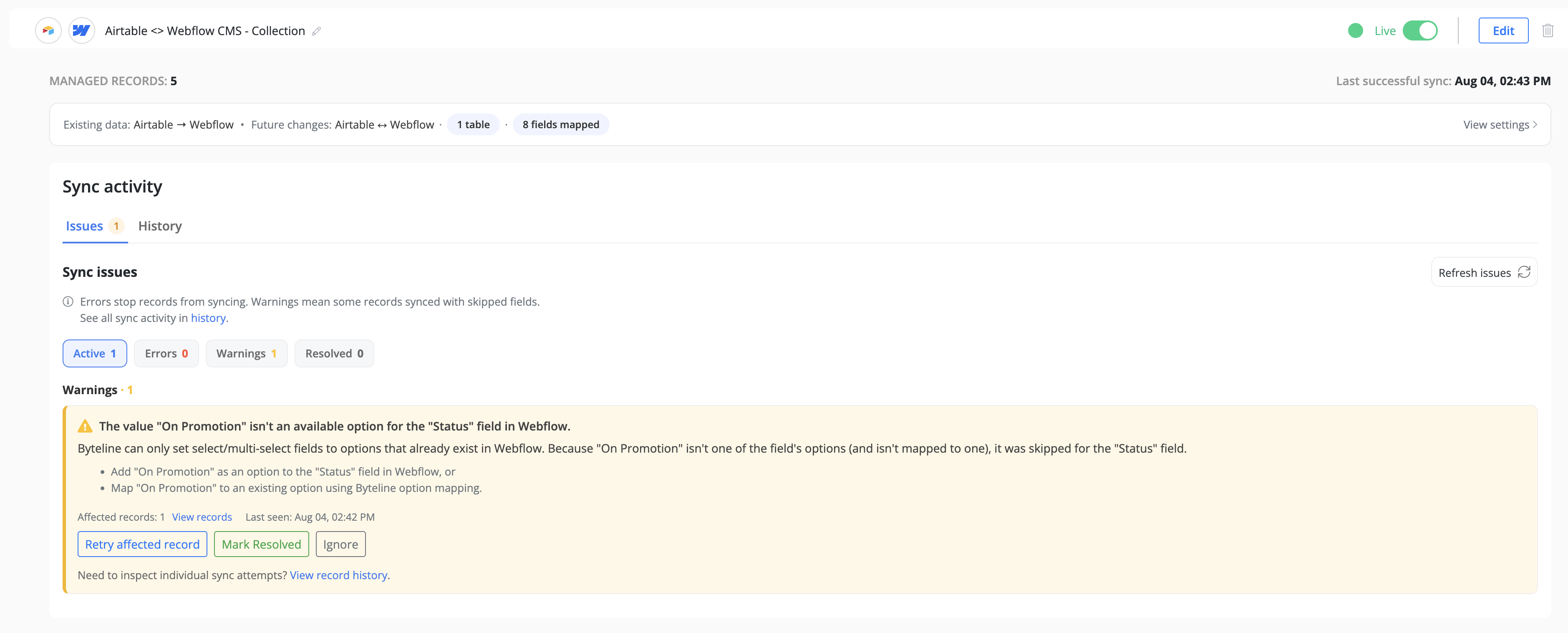
- Open the warning from the sync’s Issues page or from the warning email.
- Click Add option and retry affected records.
- Review and confirm the action.
Byteline will:
- Add the missing option to the Airtable field.
- Retry only the records affected by that missing option.
- Resolve the warning when the records sync successfully.
Mapping to an existing option
You do not have to create a new Airtable option. You can instead use Byteline’s option mapping to map the incoming value to an option that already exists.
For example, you could map the incoming value “Urgent” to the existing Airtable option “High Priority.”
Airtable Permissions
You need to have Airtable Creator access to create a Byteline data sync.
